
Dakar - The Route in 2027

Faced with a difficult situation that has led to its exceptional relocation for the 2027 edition, the Dakar is benefiting from a form of solidarity inherited from its history, particularly from Portugal and Morocco, which have agreed to open their territories to the event once again. The long-standing ties forged with these countries have been maintained by the wider rally-raid community, which has continued to gather there, notably for the W2RC rounds held in recent years.
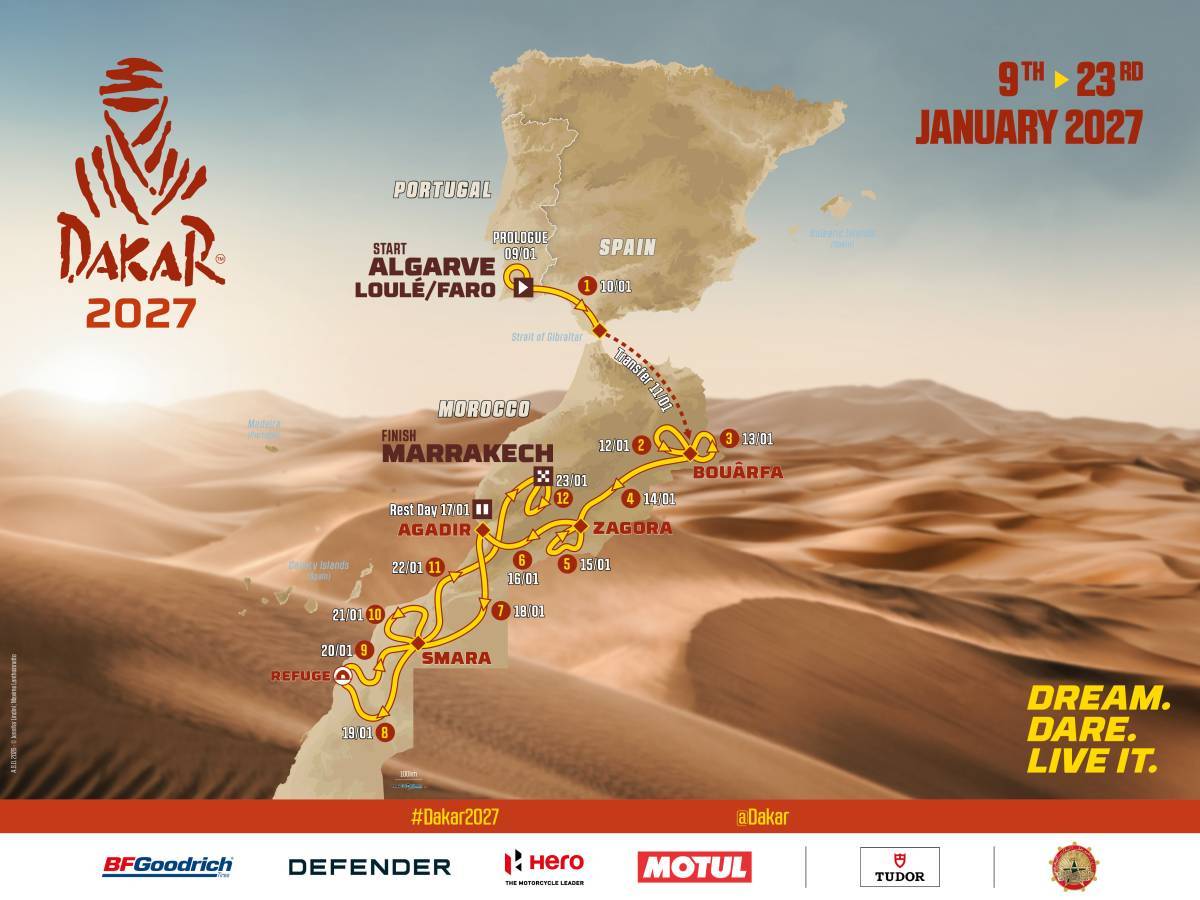
Portuguese expertise, for example, has been brought back into the spotlight over the past three seasons by the ACP (Automóvel Club de Portugal), which organised the second round of the World Rally-Raid Championship last April, finishing in Loulé-Faro, at the 30,000-seat Algarve Stadium. This arena will provide the setting for the launch of the 49th edition, which will naturally head towards Morocco, a historic ally of the event. The Kingdom of Morocco has always stood out for the quality of its deserts, which make this vast territory, still full of surprises, a sporting destination par excellence for rally-raid. Experienced in hosting international events, Morocco will be able to support the Dakar in meeting a new organisational challenge within the limited frame available.
Following the opening of the service park on 5 January in Loulé-Faro, administrative and technical scrutineering will take place there from 6 to 8 January. The sporting action will begin in Portugal on 9 January with the prologue, before the first special stage the following day. The stage will continue with a transfer to the port of embarkation for Nador, Morocco. The Mediterranean crossing will take place overnight.
Upon their arrival on the African continent on 11 January, competitors will make their way by transfer to the first Moroccan bivouac in Bouarfa. From the Oriental region, in north-eastern Morocco, the race will initially head south along the Atlas Mountains, the true backbone of the Kingdom, via Zagora, then Agadir, where the caravan will take a 24-hour break.
It will then be time to turn away from the Atlas and venture deep into the vast, distinctive deserts of the country's far south. Smara, then almost to Dakhla, will mark the furthest points on the map of the second week. From there, the caravan will begin its journey back north, once again via Smara, before following the Atlantic Ocean and reaching Marrakech, its final destination.
The route, designed over recent weeks based on the knowledge accumulated by the organising teams and a series of reconnaissance missions, meets the usual standards of the season's biggest rally-raid event, with 4,341 km of special stages, a figure close to the format of recent editions. On a daily basis, most special stages will range between 350 and 500 kilometres. A substantial average, especially in light of the specific nature of the terrain to be covered. Experts know: Morocco's deserts are among the most demanding in the world, for drivers and co-drivers as well as for their machines.