
Brian Hsu - Stark Reality

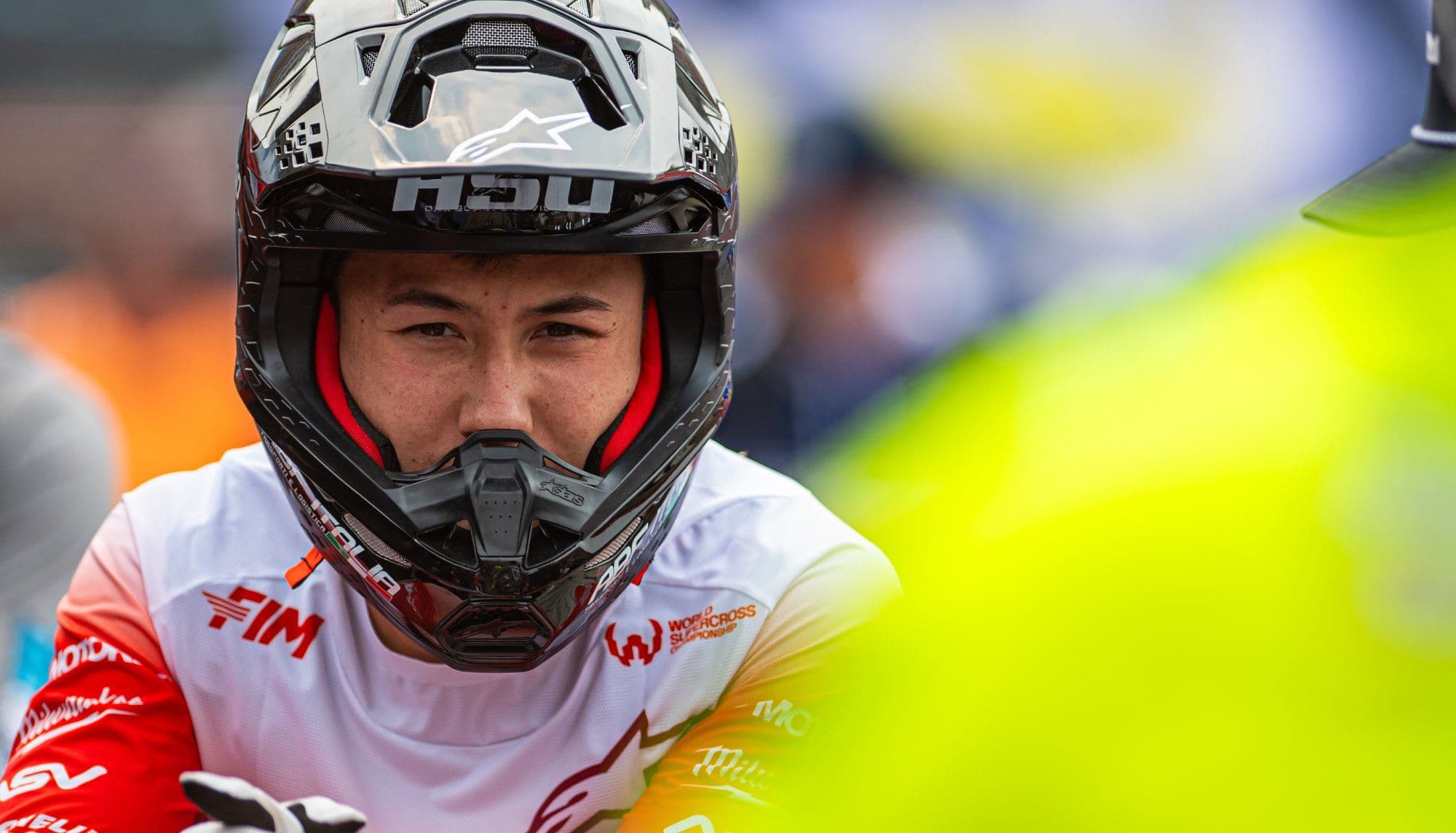
The Stark rider caught plenty of attention when he burst into the lead in Sprint Race 1 to lead the opening laps of the 2026 World Supercross Championship season. However, the German rider has an interesting background that stretches beyond the track.
Get your tickets for the British round of the WSX: Birmingham

There are riders whose stories fit neatly into the familiar mould. Father rode dirt bikes, childhood spent riding dirt bikes, family weekends at the track, early success, factory attention, and the relentless climb through the ranks. Then there is Brian Hsu.
Hsu, who rides for Stark in the World Supercross Championship, arrived in the 2026 Canadian GP with a story unlike almost anyone else in the paddock. His debut immediately became one of the talking points of the weekend, not only because he led for much of the motos, but because of how he did it. At altitude, where combustion engines can lose performance, the electric Stark offered a clear advantage—and Hsu made the most of it.
But to define him only by that debut would be to miss the richer story. Hsu is not just a supercross rider. He is a musician, a violinist, the son of a violin maker, a former student of violin making in Cremona, and a rider shaped by a life split between Germany, Taiwan, Hungary, Italy and the wider motocross world. His route to the sharp end of World Supercross has been anything but ordinary.
“I started playing when I was four,” Hsu says, explaining a childhood in which music came first, or at least arrived at the same time as motorcycles. His father was a motocross fan and a violin maker. His mother played the violin too. So, from the beginning, there were two worlds in the house: the discipline and delicacy of classical music, and the noise, speed and mud of motocross.
A Multicultural Background, Speaking Six Languages
Hsu was born in Germany, grew up in Taiwan and now lives in Italy. His family background stretches even further. His mother is Taiwanese. His father was born in Budapest and grew up in Germany. His grandparents connect him to Hungary. Ask him how many languages he speaks and he casually answers: six. The main ones are Italian, English, Mandarin, German and Hungarian, with a little French too.
It is a global upbringing that has made him unusually adaptable. Riding Supercross was never confined to one country or one scene. As a child, he raced in the United States on a 50cc bike, competed in Europe, and rode regional races in Germany, Hungary and elsewhere. His early years were spent moving between cultures, languages and tracks, learning to adjust quickly, a skill that would later become essential in World Supercross.
The decisive move came in 2008, when Hsu’s family relocated from Taiwan to Italy. It was a move with two purposes: racing and violin making. The destination was Cremona, the most famous city in the world for the craft of violin making, home to the tradition of Stradivari and the kind of place where music is not treated as heritage.
For Hsu, it was perfect and impossible at the same time. On one side, the chance to study violin making properly. On the other, motocross was beginning to demand more and more of him. He had shown enough potential on the bike for people to take notice. The path towards European racing, then world championship-level competition, was opening up.
“I got into the violin making school but because I was at the level of doing MX2 World Championship. I had to decide motocross or violin. So I chose the dirt bikes,” he says.
A Fiddly Schedule and Dedication to Competing
It sounds like the end of one life and the beginning of another, but Hsu has never quite let music go. He still plays the violin when he has time. It is not just relaxation, exactly. In fact, he makes clear that playing properly is anything but easy.
“At this level, it’s hard to keep up the violin,” he says. “If I want to get better, I have to play like six hours a day.”
That is where the similarities begin to appear. To outsiders, classical violin and supercross might seem like opposites: one quiet and refined, the other explosive and dangerous. Hsu sees them differently. Both require precision. Both require discipline. Both punish mistakes. Both demand total concentration.
“When you play, after 10 or 20 minutes, you start sweating,” he says. “Many people ask me, do you play to relax? No, it’s the opposite.”
That mentality helps explain why his transition into the World Supercross environment with Stark was so intriguing. Electric racing is still developing its identity at the top level. It brings different strengths, different demands and a different kind of riding feel. For some riders, that would be unsettling. For Hsu, sensitivity to machinery is part of the craft.
He believes music has helped him understand feel, not only through the hands, but through concentration and interpretation. A violinist learns to notice tiny variations in tone, pressure and response. A rider must notice tiny changes in grip, balance, throttle response and suspension behaviour. Hsu sees a connection.
“It helped me a lot with the feeling for the bike,” he says, “to know what is wrong with the bike, to know how to explain and give this information to the technician.”
That ability matters even more with Stark. The electric bike has different characteristics from a traditional combustion machine, particularly in power delivery. In the 2026 Canadian GP, the altitude created a natural spotlight for that difference. Combustion engines are affected when the air gets thinner; electric bikes do not suffer in the same way. Hsu’s Stark had an advantage, and he rode as if he understood exactly how to exploit it.
Get your tickets for the British GP in Birmingham
Music Remains a Passion and a Source of Inspiration
Off the bike, his musical tastes are as wide as his background. He listens to almost anything, but classical music remains central. On long trips, he might turn to Vivaldi. His great violin hero is Jascha Heifetz, whose playing Hsu admires for its precision and emotional force.
“He doesn’t show body emotions,” Hsu says of Heifetz. “But when you hear him playing, it’s emotions in the music. It’s like a machine. No mistakes.”
Hsu’s life now is based largely in Italy, though training takes him to Barcelona, conveniently close to Stark’s European base. His story also suits the emerging identity of World Supercross. The championship is global, modern and open to new ideas. Hsu embodies all of that.